


Thermoformed Tray Inserts
Designed for Durability, Organization, and Long-Term Field Use
Most people assume foam is the only option for case interiors. But if you’re managing a kit full of hardware, small parts, or field accessories that collect dirt, swap in and out, and need to stay organized, a custom thermoformed tray might be exactly what you need.
BENEFITS of
thermoformed tray inserts
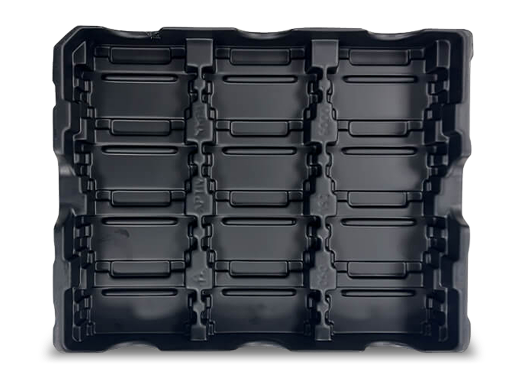
C.H. Ellis designs thermoformed trays specifically for integration inside carrying cases, including Pelican Cases, and fully custom molded systems.
Unlike disposable packaging trays, our thermoformed plastic trays are engineered to bring long-lasting organization.
Cost-Effective at Medium to High Volumes
- Lower upfront tooling cost than injection molding
- Per-unit cost drops quickly as production volume increases
- Once tooling is in place, production runs are highly efficient
Professional, High-End Appearance
- Clean, smooth surfaces deliver a consistent, polished OEM look across every unit
- Available in a variety of colors and textures (matte, gloss, etc).
- Can align with corporate branding with molded in logos, more precisely than foam
Durable & Long-Lasting
- Rigid ABS structure holds its shape through years of use
- Withstands repeated insertion and removal of parts
- Doesn’t crumble, compress, or shed particles like some foams.
Easy to Clean & Maintain
- Non-porous surface resists absorption of oils, fluids, and contaminants
- Wipes clean with standard solvents or disinfectants (depending on material)
- No crevices or foam particles to trap debris
Design Flexibility
- Defined cavities, ribbing, and finger pulls designed around your exact parts
- Stackable, multi-tiered configurations for layered case systems
- Compatible with lids, covers, and hybrid foam-and-tray setups
Is a Thermoformed Tray Insert Right for You?
The best insert for your case depends on your application. Thermoformed trays and foam inserts each have strengths, and sometimes the right answer can be both.
Foam holds parts in place and absorbs shock, which makes it the right call for fragile or sensitive items.
Thermoformed trays are a better fit when you’re organizing a mix of small parts, hardware, or accessories — items that collect dirt and need a surface that’s easy to wipe down. They won’t prevent rattling the way a tight foam fit will, but they give you defined compartments, a cleanable surface, and a polished OEM appearance that foam can’t match.
Best for
Fragile items
Recyclability
Difficult
Branding
Limited
Cleanability / Sanitation
Limited
Durability Over Time
Can compress/wear/get scratched and abraded
Upfront Tooling Cost
Very Low
Per-Unit Cost (Low Volume)
Low
Per-Unit Cost (High Volume)
Moderate
Best Volume Range
1–1000
Lead Time (Initial)
Fast
Best for
Hardware, small parts, OEM kits
Recyclability
Highly recyclable
Branding
Excellent
Cleanability / Sanitation
Good
Durability Over Time
Excellent
Upfront Tooling Cost
Low–Moderate
Per-Unit Cost (Low Volume)
Moderate
Per-Unit Cost (High Volume)
Low
Best Volume Range
250–25,000
Lead Time (Initial)
4-8 Weeks
Is a Thermoformed Tray Insert Right for You?
The best insert for your case depends on your application. Thermoformed trays and foam inserts each have strengths, and sometimes the right answer can be both.
Foam holds parts in place and absorbs shock, which makes it the right call for fragile or sensitive items.
Thermoformed trays are a better fit when you’re organizing a mix of small parts, hardware, or accessories — items that collect dirt and need a surface that’s easy to wipe down. They won’t prevent rattling the way a tight foam fit will, but they give you defined compartments, a cleanable surface, and a polished OEM appearance that foam can’t match.
Here's how the two compare:
Category
Foam Inserts
Thermoformed Trays
Best For
Fragile items
Hardware, small parts, OEM kits
Recyclability
Difficult
Highly recyclable
Branding
Limited
Excellent
Cleanability / Sanitation
Limited
Good
Durability Over Time
Can compress/wear/get scratched and abraded
Excellent
Upfront Tooling Cost
Very Low
Low–Moderate
Per-Unit Cost (Low Volume)
Low
Moderate
Per-Unit Cost (High Volume)
Moderate
Low
Best Volume Range
1–1000
250–25,000
Lead Time (Initial)
Fast
4-8 Weeks
BENEFITS of
thermoformed tray inserts
Field Service & Technician Tool Kits
Manufacturers packaging standardized kits (tools, hardware sets, repair kits, spare parts) often use thermoformed inserts.
OEM Equipment & Accessory Kits
Manufacturers packaging standardized kits (tools, hardware sets, repair kits, spare parts) often use thermoformed inserts.
Calibration & Measurement Accessory Kits
Thermoformed trays are a strong fit for organizing the adapters, fittings, and accessories that travel with the equipment.
Multi-Layer Case Systems
Stackable thermoformed trays are often used in carrying cases where components are separated by tier.
The c.h. ellis approach:
Industrial Support, Individual Attention.
We’ve been in business for over 120 years. That experience means we understand what field-deployed equipment actually demands and we engineer our thermoformed trays to meet it.
When you come to C.H. Ellis for thermoformed tray inserts, here’s what you get:
We match material type and tray design to your specific use case, environment, and budget so you get the right solution, not just a quote.
Expert Guidance
Two in-house thermoforming machines and in-house soft tooling give us direct control over lead times, consistency, and quality.
Built In-House
Need structure and cushioning? We combine thermoformed trays with custom foam when your application calls for both
Hybrid Systems
As a hard case manufacturer and authorized Pelican distributor, we can design your tray insert and source the case in a single order — no dimensional mismatches, no finger-pointing.
One Vendor, On Spec
We match material type and tray design to your specific use case, environment, and budget so you get the right solution, not just a quote.
Expert Guidance
Two in-house thermoforming machines and in-house soft tooling give us direct control over lead times, consistency, and quality.
Built In-House
Need structure and cushioning? We combine thermoformed trays with custom foam when your application calls for both
Hybrid Systems
As a hard case manufacturer and authorized Pelican distributor, we can design your tray insert and source the case in a single order — no dimensional mismatches, no finger-pointing.
One Vendor, On Spec
Which tray style is right for your project?
Contact us today and our in-house design and manufacturing experts will review your needs to ensure the best fit for your project.
Thermoformed Tray FAQs
What production volume makes thermoforming cost-effective?
Thermoformed trays are typically most cost-effective for medium to high production volumes. Because tooling costs are lower than injection molding, they offer an excellent balance between upfront investment and per-unit cost. For growing or long-term programs, thermoforming provides strong value without the high tooling expense of injection molding.
How much does tooling cost and how long does it take?
Most tooling comes in under $10,000 and often under $5,000 for simpler tray designs. From design approval to first articles, expect roughly 4–8 weeks. Modifications to existing tooling are more manageable and cost-effective than adjusting hard injection molds.
How durable are thermoformed trays?
Thermoformed ABS trays maintain their shape through years of repeated use and part removal. Unlike foam, they won’t compress, crumble, or shed particles over time, making them a strong choice for kits that see regular field deployment.
Will a thermoformed tray provide enough protection for my product?
Thermoformed trays are designed for organization and presentation, not shock absorption. Items sit in defined cavities and are kept separate from one another, but smaller parts may have some movement within the cavity depending on fit. If your products require cushioning from drops or vibration, foam or a hybrid system is the right path.
Can thermoformed trays be customized to match our brand?
Yes. Thermoformed trays are available in a variety of materials, colors, and finishes. They can be designed to align with brand standards and create a clean, professional presentation that enhances perceived product quality.
Are thermoformed trays easy to clean?
Yes. The non-porous plastic surface makes thermoformed trays easy to wipe down and maintain. They are well-suited for environments that require regular cleaning, such as medical, laboratory, or industrial settings.
What materials are available, and are they recyclable?
C.H. Ellis thermoformed trays are produced in ABS, a fully recyclable thermoplastic. This is a genuine advantage over foam, which is notoriously difficult to recycle and typically ends up in landfill.