


When you’re designing a product that needs protection, presentation, and repeatable performance, packaging is part of the engineering decision. For engineers and procurement teams working through the early design phase, the interior solution needs to hold the product securely, consistently, and at scale.
Plastic thermoformed trays meet that requirement across a wide range of applications. Understanding how they’re made gives you a clearer picture of what they can do for your specific case, and helps you spec the right solution from the start.
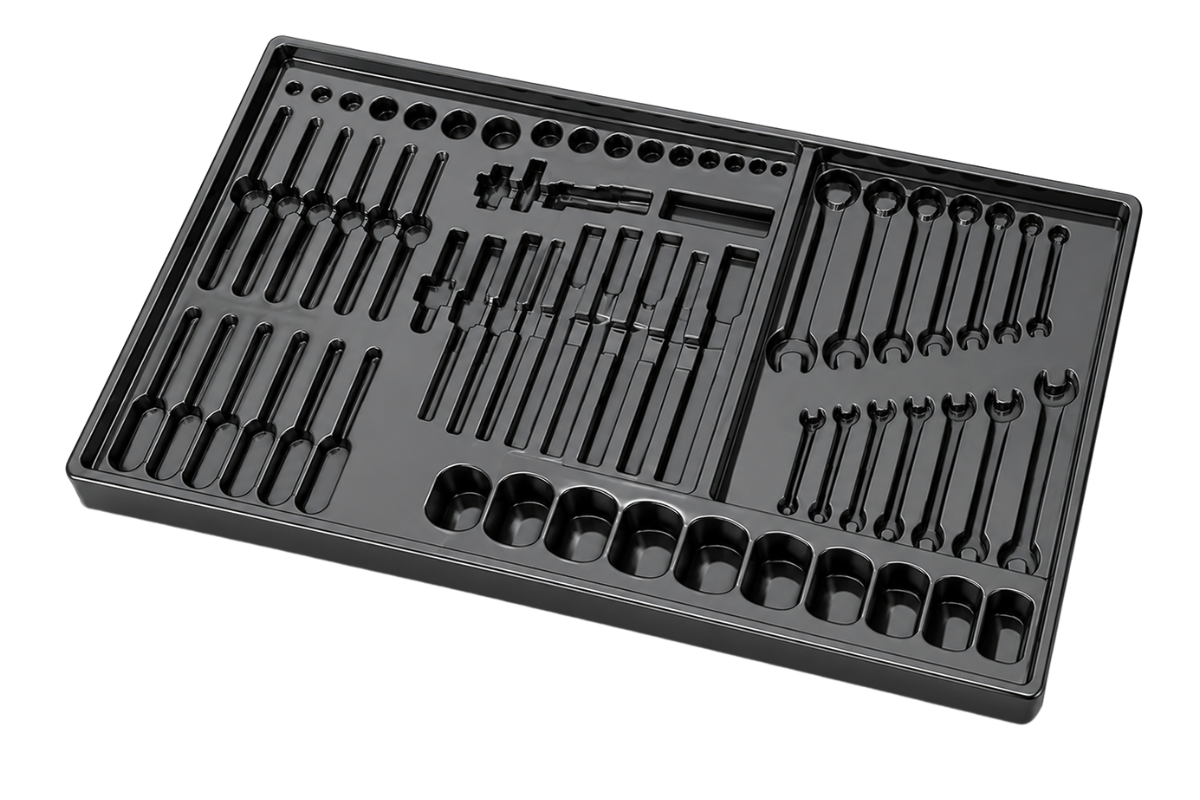
What Are Plastic Thermoformed Trays?
Plastic thermoformed trays are created by heating a plastic sheet until it becomes pliable, then forming it over a mold using vacuum pressure. Once cooled, the plastic retains the shape of the mold, creating a precise, repeatable cavity for parts or products.
This process is often referred to as vacuum forming, especially when vacuum pressure is the primary forming method. The result is a lightweight, durable tray that is custom-fit to the product it protects.
How Thermoformed Trays Are Made
1. Material Selection
CH Ellis uses Polyethylene and ABS, each offering different advantages depending on the application. Both materials are available in a range of colors and textures, allowing for customization in both performance and appearance.
For example:
- ABS is often used for durability and impact resistance
- PET is preferred for clarity and recyclability
- HIPS is a cost-effective option for lighter-duty applications
2. Tooling Design
A mold is created based on the exact geometry of the product. This is where expertise matters most. A well-designed tool ensures consistent wall thickness, proper draft angles, and clean part release.
3. Heating and Forming
The plastic sheet is heated and then draped over the mold. Vacuum pressure pulls the material tightly against the mold surface, capturing every detail.
4. Cooling and Trimming
After forming, the trays are cooled and trimmed to final dimensions. This process provides consistent, reliable results that are well-suited for medium to high-volume production.
Why This Process Matters for Custom Cases
The manufacturing method directly impacts how a tray performs in the field. Here are the factors that matter most during the design phase:
- Cost-Effective at Medium to High Volumes: Lower upfront tooling cost than injection molding, with per-unit costs decreasing quickly as volume increases. Once tooling is complete, production runs are fast and efficient.
- Professional, High-End Appearance: Clean, smooth surfaces deliver a consistent, polished OEM look. Available in a range of colors and textures, with molded-in logos for precise, durable branding.
- Durable & Long-Lasting: Rigid ABS construction holds its shape through repeated use. Trays withstand constant part handling without crumbling, compressing, or shedding particles like some foams.
- Easy to Clean & Maintain: Non-porous surfaces resist oils, fluids, and contaminants. Trays wipe clean easily and don’t trap debris, making them ideal for controlled environments.
- Design Flexibility: Custom cavities, ribbing, and finger pulls are designed around your exact parts. Supports stackable layouts, multi-tier systems, and integration with lids or hybrid foam-tray designs.
Comparing Thermoformed Trays to Foam Inserts
Thermoformed trays offer strong performance without the high upfront investment of injection molding. However, like any packaging solution, they’re best suited for specific applications.
Choosing the right interior solution depends on your priorities. Here is how thermoformed trays compare to common alternatives.
| Category | Foam Inserts | Thermoformed Trays |
| Best For | Fragile items | Hardware, small parts, OEM kits |
| Recyclability | Difficult | Highly recyclable |
| Branding | Moderate | Excellent |
| Cleanability / Sanitation | Limited | Excellent |
| Durability Over Time | Can compress/wear/get scratched and abraded | Excellent |
| Upfront Tooling Cost | Very Low | Low–Moderate |
| Per-Unit Cost (Low Volume) | Low | Moderate |
| Per-Unit Cost (High Volume) | Moderate | Low |
| Best Volume Range | 1–1000 | 250–25,000 |
| Lead Time (Initial) | Fast | 4-8 Weeks |
When Thermoformed Trays Are the Right Choice
Thermoformed trays work best when the application has defined requirements around fit, volume, and presentation.
- You need consistent protection across multiple units
- Your product has defined geometry that benefits from a custom fit
- You are producing at moderate to high volumes
- Presentation matters, especially for customer-facing applications
- You want a balance between cost and performance
Design Considerations That Get Overlooked
Getting these details right early keeps the project on track and reduces the chance of costly revisions later.
- Part Orientation: How the product sits in the tray affects both usability and protection. A solid design accounts for how the item will be removed and replaced in regular use.
- Tolerances: Thermoforming requires proper draft angles and spacing. Building these into the design from the start ensures a clean fit and smooth production.
- Integration with the Case: The tray needs to work with the case as a complete system. That includes stacking configuration, fastening method, and overall interior layout.
- Future Iterations: If the product design may evolve, the tray should be designed with that in mind. Planning for small changes up front avoids the need for new tooling later.
What to Look for in a Thermoformed Tray Manufacturer
Choosing a thermoformed tray means choosing a manufacturing approach and a partner.
A well-executed thermoformed tray reflects decisions made early in the design process. Those decisions affect cost, performance, and long-term usability.
Manufacturers that specialize in custom case interiors bring more than production capability. They bring design insight, material knowledge, and experience across industries. That combination turns a packaging component into a functional part of your product system
Working with C.H. Ellis on Your Next Custom Case
Plastic thermoformed trays are a proven solution for applications that demand consistent fit, repeatable protection, and clean presentation across every unit.
C.H. Ellis works with engineering and procurement teams from early design through production, bringing material knowledge and case interior expertise to each project: Talk to Our Team